
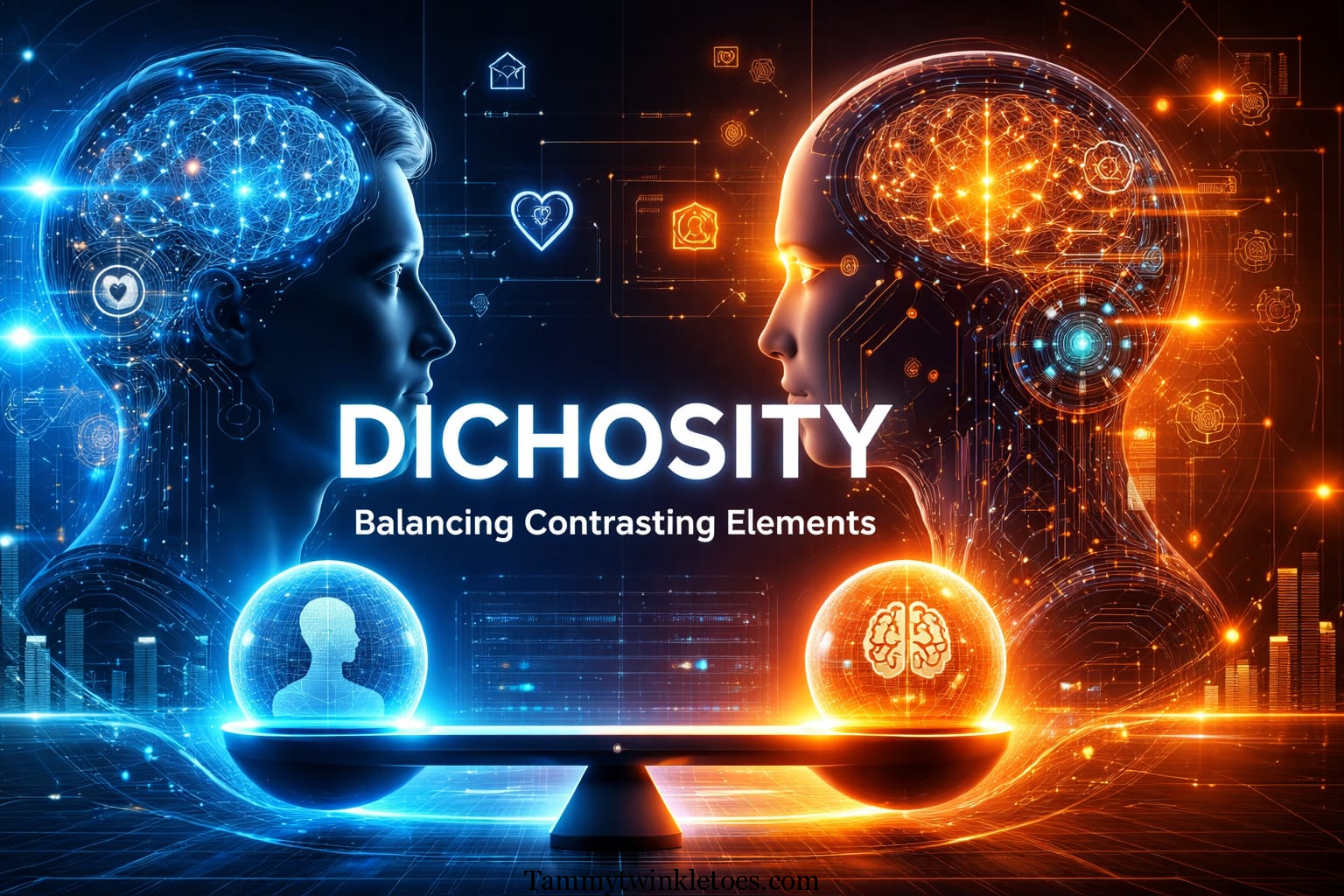
In a world overflowing with complexity, understanding how we perceive, analyse, and make decisions is more important than ever. One concept that has gained significant attention across multiple disciplines is dichosity. Often confused with dichotomy or duality, dichosity is a framework for understanding systems, concepts, or processes that are divided into two complementary or contrasting parts. Unlike strict dichotomies, allows these two elements to coexist and interact, providing a deeper understanding of relationships and patterns.
The term comes from the prefix di-, meaning two, combined with a conceptual root related to branching or division. At its essence, it reflects the human tendency to organise information through dual structures breaking down complex ideas into simpler, interpretable components. From cognitive psychology to business strategy, philosophy, and modern technology has become a vital tool for decision-making, analysis, and problem-solving.
What Is Dichosity
Dichosity represents the structured division of a concept, system, or process into two interconnected components that often operate in contrast or complementarity. Unlike a strict dichotomy, which enforces rigid separation, dichosity allows for overlap, interaction, and balance, providing deeper insights that a singular perspective might miss.
In everyday life, dichosity is evident in situations such as balancing work and life commitments, weighing logic against emotion when making decisions, evaluating risk versus reward in investments or business strategies, and navigating innovation alongside tradition in professional or creative pursuits. By recognising these dual perspectives, individuals can approach complex scenarios with greater clarity, make more informed choices, and achieve a more balanced, holistic understanding of the challenges they face.
Historical and Intellectual Roots of Dichosity
Throughout history, scholars and philosophers have explored dualistic frameworks to make sense of the world. Dichosity has its roots in philosophical dualism, which posits that reality consists of two fundamental principles, such as mind and matter or good and evil. Ancient philosophers often used duality to explore metaphysical questions, moral dilemmas, and logical reasoning.
As disciplines evolved, dichotic thinking became a practical tool beyond philosophy:
- Biology Observing dual structures like symmetrical branching in plants or the bilateral symmetry of animals.
- Psychology Understanding cognitive processes such as contrasting emotions and personality traits.
- Economics Analysing supply and demand as two interacting forces that determine market dynamics.
- Technology Applying binary logic in computing and AI systems to structure complex operations.
This historical evolution shows that is not merely theoretical it is embedded in natural systems, human thought, and practical problem-solving.
Psychological Perspectives on Dichosity
Human cognition relies heavily on categorisation, using dual structures to simplify the vast flow of information the brain encounters. In psychology, dichosity helps explain internal conflicts, cognitive dissonance, and the processes behind decision-making. For instance, emotion processing often exhibits dichotic patterns, as we may experience opposing feelings like excitement and anxiety simultaneously. Similarly, decision-making frequently depends on binary frameworks, such as safe versus risky or beneficial versus harmful, enabling rapid judgments in complex situations.
Recognising dichotic patterns also fosters cognitive flexibility, allowing individuals to weigh multiple perspectives and adapt their thinking more effectively. However, psychologists warn that overreliance on rigid dual categories can oversimplify reality, potentially leading to errors in judgment and a distorted understanding of nuanced situations.
Dichosity in Philosophy
In philosophy, dichosity serves as a powerful tool for clarifying complex concepts through contrast. Philosophers frequently employ it to examine abstract ideas, moral dilemmas, and ethical decisions, offering a structured way to navigate opposing forces. Classic examples include the tension between good and evil, which frames morality through conflicting ethical principles; freedom versus control, which considers the balance between individual autonomy and societal regulations; and mind versus body, which explores the dynamic relationship between thought and physical existence.
Modern philosophical thought, however, recognises the limitations of strict dichotic reasoning. Rather than enforcing rigid separation,emphasises integration, showing how opposing forces interact to produce a more nuanced and comprehensive understanding of reality.
Technological Applications of Dichosity
Dichosity plays a crucial role in modern technology, especially within human-AI hybrid systems, where it embodies the delicate balance between human intuition and machine computation. In practical applications, dichosity facilitates AI and human collaboration, allowing artificial intelligence to handle complex, data-intensive tasks while humans provide oversight, ethical judgment, and contextual understanding. In software design, interfaces often incorporate dual options that simplify decision-making and enhance user experience, reflecting dichotic principles.
Digital systems also implement at a foundational level through binary computing, which relies on two-state logic of 0s and 1s. Additionally, industrial processes benefit from the combination of automation and human input, ensuring both efficiency and reliability. By harnessing dichosity, technology systems become more adaptive, intelligent, and resilient, solving problems that neither humans nor AI could address alone.
Business and Leadership Applications
In the realm of business, dichosity serves as a guiding principle for strategic decision-making, team management, and innovation planning. Leaders constantly navigate contrasting priorities such as efficiency versus creativity, innovation versus stability, and short-term gains versus long-term growth.
By applying dichotic frameworks, organisations can remain agile and responsive to dynamic market conditions, balancing immediate operational needs with visionary goals. Hybrid leadership models, which integrate analytical rigor with intuitive insight, exemplify this approach, fostering more effective decision-making, enhancing team collaboration, and ultimately improving overall organisational performance.
Dichosity Cultural and Social Perspectives
Dichosity also provides a valuable lens for understanding social structures, cultural dynamics, and human behaviour. Communities and societies often operate through complementary yet opposing roles, such as tradition versus innovation, individual identity versus collective belonging, and conformity versus rebellion.
By recognising these dichotic patterns, leaders, educators, and policymakers can better navigate social tensions, promote dialogue, and foster cooperation. This perspective not only supports inclusion but also mitigates conflicts that arise from rigid binary thinking, enabling societies to embrace diversity while maintaining cohesion.
Benefits of Understanding Dichosity
The advantages of applying dichosity across disciplines are extensive:
- Enhanced Decision-Making Encourages weighing multiple perspectives before choosing a course of action.
- Improved Analytical Skills Supports structured analysis of complex systems.
- Innovation Sparks creativity by recognising the interaction between opposing forces.
- Emotional Intelligence Enhances awareness of conflicting emotions and thought patterns.
- Adaptability Prepares individuals and organisations to manage uncertainty and dynamic challenges.
By embracing dichosity, individuals gain clarity without oversimplification, fostering smarter personal and professional choices.
Challenges and Limitations of Dichosity
Despite its many advantages, dichosity comes with certain limitations that must be considered. One key drawback is the risk of oversimplification, as reducing complex situations to just two categories can overlook important nuances and alternative options. Additionally, cognitive overload can occur when individuals attempt to analyse multiple opposing factors simultaneously, making decision-making mentally taxing.
Another concern is the rigid application of dichotic thinking treating it as an absolute framework may constrain creativity and limit innovative problem-solving. To harness dichosity effectively, it is essential to balance its use with broader, multi-dimensional perspectives, ensuring decisions are both insightful and adaptable.
Real World Examples of Dichosity
Dichosity plays a vital role across various sectors, demonstrating its practical value in solving complex problems. In healthcare, AI algorithms can efficiently analyse medical scans, while doctors provide the crucial final diagnosis, ensuring accuracy and ethical oversight. In finance, algorithmic trading is closely monitored by human analysts to prevent costly errors and maintain market stability.
Education benefits from AI tutors that adapt to student input, complemented by teachers who guide critical thinking and personalised learning. In marketing, brands strategically balance contrasting elements such as luxury versus affordability or tradition versus innovation to appeal to diverse audiences. Social systems also reflect dichotic thinking, as legal frameworks navigate the tension between individual rights and collective welfare. These examples underscore how enables more adaptive, balanced, and effective solutions across multiple domains.
How to Apply Dichosity in Daily Life
- Recognise Opposing Forces Identify the two contrasting elements in any scenario.
- Analyse Interactions Examine how the elements influence each other.
- Find Balance Seek solutions that integrate both perspectives.
- Practice Adaptive Thinking Be flexible in considering multiple outcomes.
- Avoid Oversimplification Acknowledge overlapping or intermediary options.
By following these steps, dichosity can become a daily tool for smarter decision-making and problem-solving.
Future of Dichosity
The relevance of dichosity is expected to grow in the coming years. Emerging technologies like generative AI, quantum computing, and hybrid human-machine systems will rely heavily on dual frameworks for efficiency, ethics, and innovation. In addition, psychological and educational research increasingly emphasises dual-structured thinking to develop cognitive flexibility and critical reasoning.
As we approach a more interconnected and complex world, understanding dichosity provides a framework for integrating opposites, ensuring that individuals and organisations are better equipped to handle complexity, ambiguity, and rapid change.
Conclusion
Dichosity is far more than a conceptual tool it is a practical framework for understanding complexity across psychology, philosophy, business, technology, and social systems. By dividing systems into two complementary or contrasting elements, it allows for clearer analysis, better decision-making, and improved innovation.
While dichotic thinking has limitations, recognising its presence and influence in everyday life empowers individuals to embrace multiple perspectives, reduce cognitive bias, and enhance strategic thinking.
FAQs
Is dichosity the same as dichotomy?
Not exactly. Dichotomy enforces strict separation, while dichosity allows interaction and coexistence between two elements.
Where is dichosity used?
It is used in psychology, philosophy, business strategy, technology, education, and social sciences.
Can dichosity oversimplify complex problems?
Yes. Overreliance on two categories can neglect nuance and overlapping factors.
How does dichosity improve decision-making?
By recognising opposing forces and evaluating their interactions, dichosity enhances clarity, balance, and strategic thinking.